Define a local replacement.
A fixed rule identifies target content. Blend selected arm joints toward a neutral pose, smooth the transition, then recompute velocities and forward kinematics.
HUMANOID MOTION CONTROL
Local motion content redaction
for humanoid whole-body control.
RedirectMimic fine-tunes a motion tracker to replace selected arm movements. The actor still receives the original motion.

SEE THE BEHAVIOR
Original input. A local replacement.
Watch the response, then compare the training objectives.
Local replacement in action · 35 sec · G1 simulation · 1x speed
Download showcaseSelected demonstrations at original speed, with synchronized method comparisons. Blue and orange ghosts mark the original and edited arm references. Watch the full five-controller comparison ↗. Aggregate results below cover the complete evaluation sets.
THE IDEA
A reference motion can contain both useful behavior and a local movement we want to replace. RedirectMimic separates what the policy sees from what it is trained to execute.
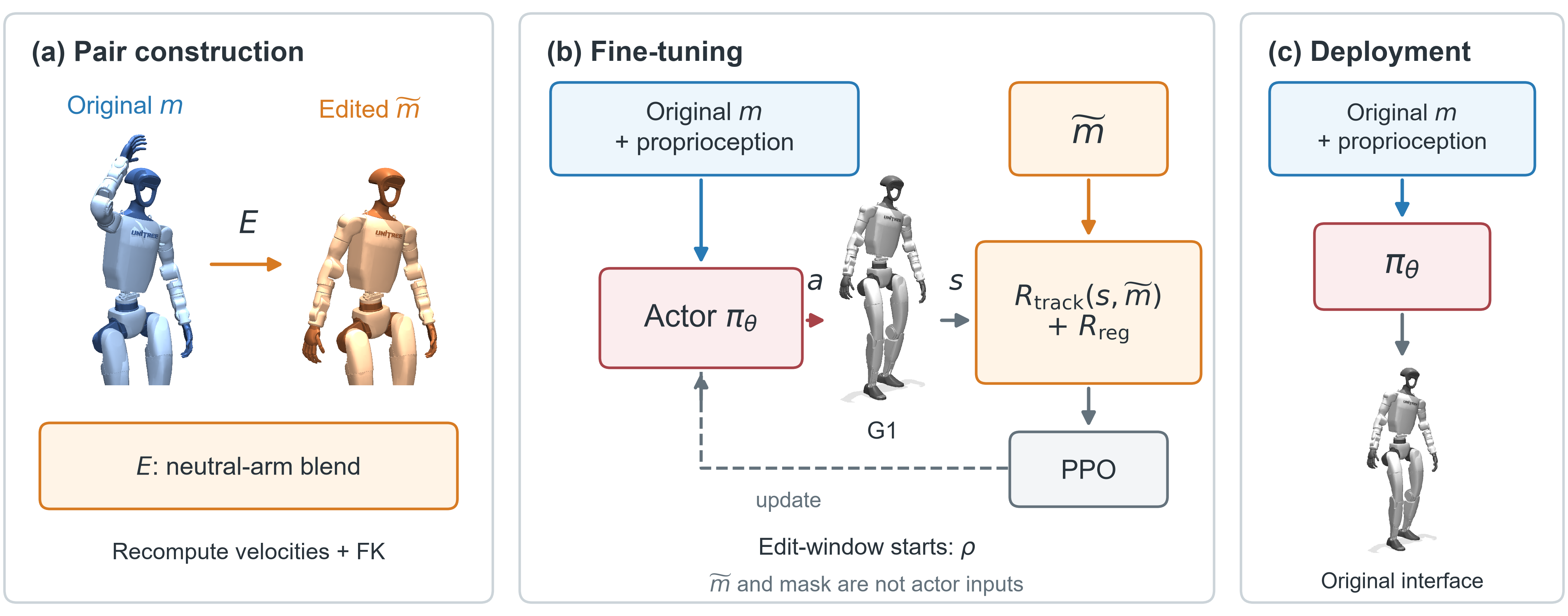
A fixed rule identifies target content. Blend selected arm joints toward a neutral pose, smooth the transition, then recompute velocities and forward kinematics.
Ordinary PPO updates the tracker. The actor sees original m and proprioception; tracking rewards use edited m̃. Edit-window start sampling focuses the updates.
Send the original reference to the fine-tuned policy. No edit mask, motion ID, or edited reference is added to the actor input.
THE EVIDENCE
Reliable pose replacement.
Target fidelity beyond speed suppression.
POSE RULE · WRIST ABOVE SHOULDER
RedirectMimic achieves 94.2% joint success on overhead-arm windows, compared with 65.0% for anti-tracking and 40.8% for reward zeroing.
| Controller | Joint success ↑ | Content ↓ | Edited-arm error ↓ | Falls ↓ |
|---|
149 prospectively filtered windows · 96 clips · 16 rollouts per window · 2,384 rollouts per controller.
RedirectMimic has lower mean replacement error than both local baselines in 15 of the 16 archived S2 source groups. These are descriptive group averages on the evaluated clips, not unseen-source generalization. The complete breakdown includes the exception and fall rates.
| Source | AntiTrack error | ZeroTrack error | Ours error | AntiTrack falls | ZeroTrack falls | Ours falls |
|---|---|---|---|---|---|---|
| BMLhandball | 0.244 m | 0.250 m | 0.034 m | 0.0% | 0.0% | 0.0% |
| BMLmovi | 0.241 m | 0.272 m | 0.023 m | 0.0% | 0.0% | 0.0% |
| BioMotionLab_NTroje | 0.166 m | 0.210 m | 0.079 m | 2.9% | 3.3% | 7.7% |
| CMU | 0.161 m | 0.227 m | 0.117 m | 0.0% | 0.0% | 0.0% |
| DanceDB | 0.146 m | 0.220 m | 0.122 m | 3.1% | 1.6% | 4.7% |
| Eyes_Japan_Dataset | 0.170 m | 0.231 m | 0.045 m | 0.0% | 0.0% | 0.0% |
| GRAB | 0.187 m | 0.260 m | 0.116 m | 0.0% | 0.0% | 0.0% |
| HUMAN4D | 0.159 m | 0.244 m | 0.057 m | 0.8% | 0.8% | 0.8% |
| HumanEva | 0.199 m | 0.247 m | 0.072 m | 0.0% | 0.0% | 0.0% |
| KIT | 0.171 m | 0.225 m | 0.090 m | 0.0% | 0.0% | 0.0% |
| MPI_HDM05 | 0.163 m | 0.198 m | 0.063 m | 0.0% | 0.0% | 0.0% |
| MPI_Limits | 0.228 m | 0.264 m | 0.150 m | 0.0% | 0.0% | 0.0% |
| MPI_mosh | 0.148 m | 0.176 m | 0.084 m | 0.0% | 0.4% | 0.0% |
| SOMA | 0.148 m | 0.224 m | 0.084 m | 3.9% | 7.0% | 6.2% |
| TotalCapture | 0.135 m | 0.188 m | 0.071 m | 6.2% | 3.8% | 13.8% |
| Transitions_mocap | 0.136 m | 0.203 m | 0.188 m | 0.0% | 6.2% | 43.8% |
Source-group sample counts are unavailable in the archived summary. Individual rollout distributions require the original evaluation records.
| Task | Controller | Joint ↑ | Content ↓ | Target error ↓ | Fall ↓ | Retain ↑ | Keep/core ↓ | Keep/out ↓ |
|---|---|---|---|---|---|---|---|---|
| S2 | Pretrained | 24.5% | 73.7% | 0.238 m | 1.4% | 96.4% | 0.052 m | 0.045 m |
| S2 | Vanilla-FT | 21.8% | 77.4% | 0.237 m | 1.1% | 96.8% | 0.049 m | 0.043 m |
| S2 | AntiTrack | 65.0% | 32.8% | 0.171 m | 0.9% | 97.7% | 0.044 m | 0.042 m |
| S2 | ZeroTrack | 40.8% | 58.9% | 0.224 m | 1.1% | 97.7% | 0.042 m | 0.039 m |
| S2 | RedirectMimic | 94.2% | 2.7% | 0.079 m | 2.2% | 97.0% | 0.044 m | 0.044 m |
| S2 | RefEdit (oracle) | 97.2% | 0.3% | 0.046 m | 1.3% | 97.4% | 0.048 m | 0.044 m |
| S1 | Pretrained | 72.5% | 10.5% | 0.177 m | 8.9% | 83.6% | 0.089 m | 0.078 m |
| S1 | Vanilla-FT | 74.5% | 12.0% | 0.177 m | 7.9% | 86.8% | 0.083 m | 0.073 m |
| S1 | AntiTrack | 85.7% | 2.3% | 0.174 m | 6.1% | 88.8% | 0.078 m | 0.068 m |
| S1 | ZeroTrack | 89.7% | 2.0% | 0.158 m | 4.9% | 92.0% | 0.073 m | 0.065 m |
| S1 | RedirectMimic | 87.4% | 2.3% | 0.143 m | 6.4% | 89.9% | 0.080 m | 0.068 m |
| S1 | RefEdit (oracle) | 80.3% | 0.0% | 0.079 m | 10.3% | 82.6% | 0.088 m | 0.080 m |
Keep/core and Keep/out measure preserved-body error inside and outside the edit interval. All values use the original evaluation sets.
Content: the fraction of rollouts exhibiting the specified event in the core edit window. Falls: pelvis height below 0.35 m anywhere in the rollout. Retention: retained-body core-window error within 0.10 m of the original reference.
Joint success requires no core-window content, no fall during the evaluation horizon, and retention within tolerance. Edited-arm error is the core-window target-arm body-position error to the edited reference, in meters. The reported content and retention metrics do not establish preservation over every frame.
One training seed (seed 0), known source clips, fresh evaluation rollouts. RefEdit is an oracle with additional deployment information. VanillaFT is a continued-training control with different sampling and termination settings. Best non-oracle values are bold and second-best values are underlined, including displayed ties. See the paper for evaluation protocols.
A CLOSER LOOK
A local editing task,
with explicit boundaries.
That is a useful engineering solution when edited references are available at deployment. RefEdit tests exactly this option. RedirectMimic studies a different interface constraint: the actor continues to receive the original reference.
No. For speed-defined striking, reducing motion can cross the content threshold without closely following the edited target. RedirectMimic reduces edited-arm error, but ZeroTrack has the higher joint-success point estimate on this task.
On a separate set of 200 normal clips, RedirectMimic has similar mean tracking error to the pretrained tracker: 0.067 vs. 0.070 m after striking fine-tuning, and 0.070 vs. 0.070 m after overhead-arm fine-tuning. These averages do not guarantee preservation of every motion or time segment.
The current study is simulation-only and uses one training seed. It evaluates known source clips with new rollouts; it does not demonstrate unseen-source generalization, hardware deployment, automatic content recognition, or a formal safety guarantee. Some clips still exhibit the target content.
The showcase uses the existing curated supplementary set: cup drinking, throwing, stretching, and martial arts. Clips were inspected and selected for clear comparisons. Their visual success should not be interpreted as the dataset success rate; the tables summarize all eligible evaluation rollouts.
READ THE STUDY
Local Motion Content Redaction
for Humanoid Whole-Body Control
Working manuscript · October 2026 · 31 references