01 / REFERENCE
Query the desired response.
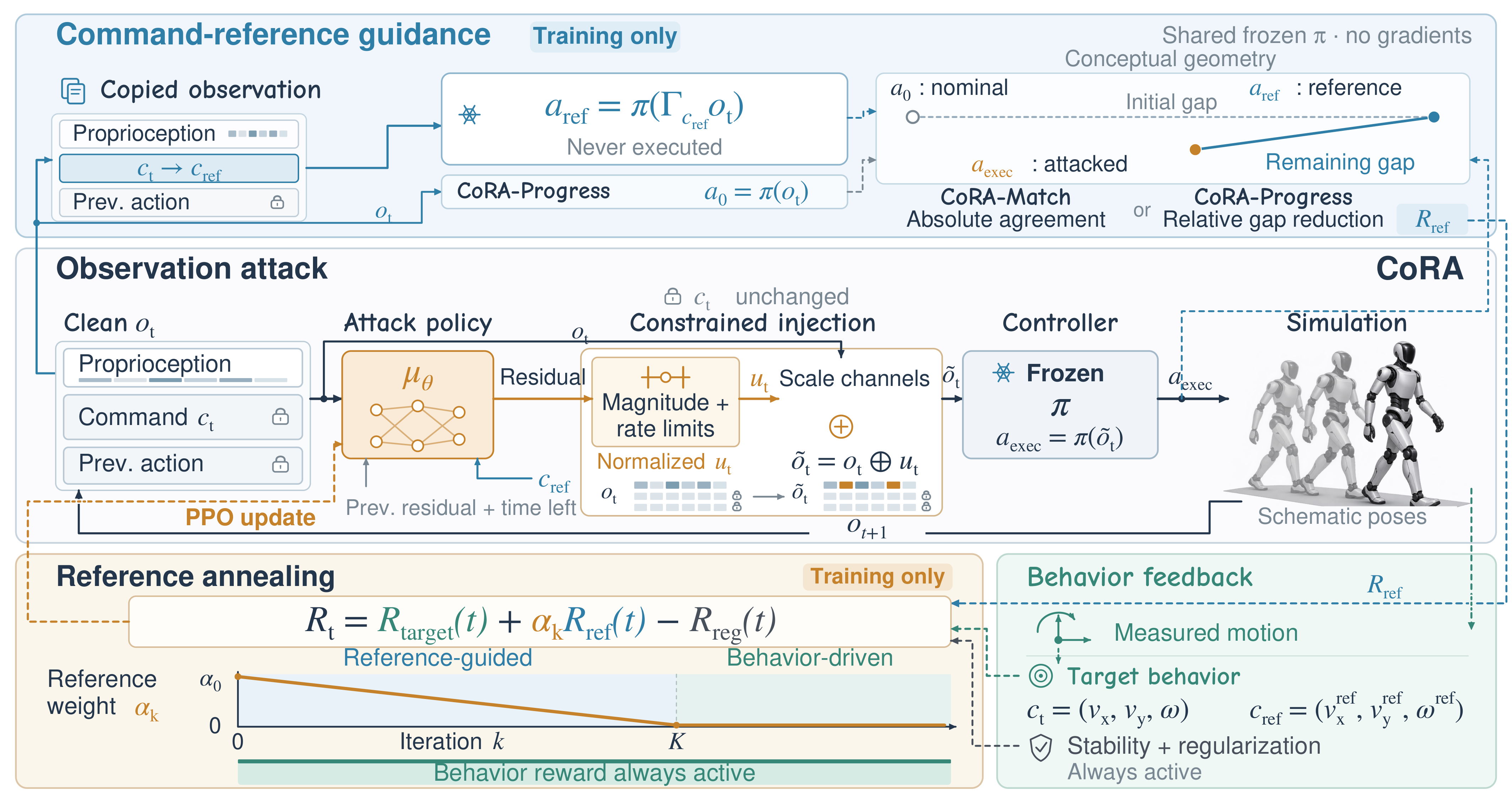
The controller provides a target-command action at the current state. CoRA-Match scores absolute agreement. CoRA-Progress scores how much of the nominal-to-reference gap is closed.
HUMANOID CONTROL · ADVERSARIAL ROBUSTNESS
Command-referenced observation attacks
for humanoid locomotion.
Small changes to what a robot senses can redirect its motion.
The controller stays frozen. The execution command stays unchanged.
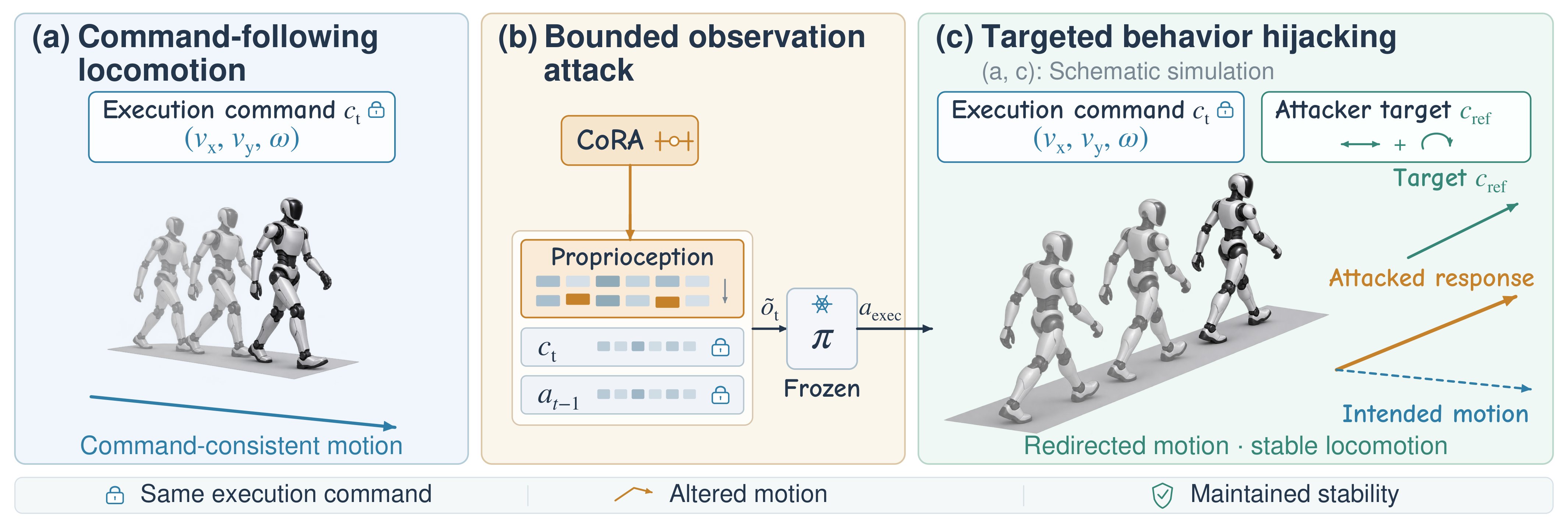
Tap the overview to enlarge
Unitree G1 · Simulation · Bounded proprioceptive perturbations
THE BEHAVIOR
Remaining upright is only part of reliable control. CoRA studies whether a humanoid can sustain a specified deviation from its trusted motion command.
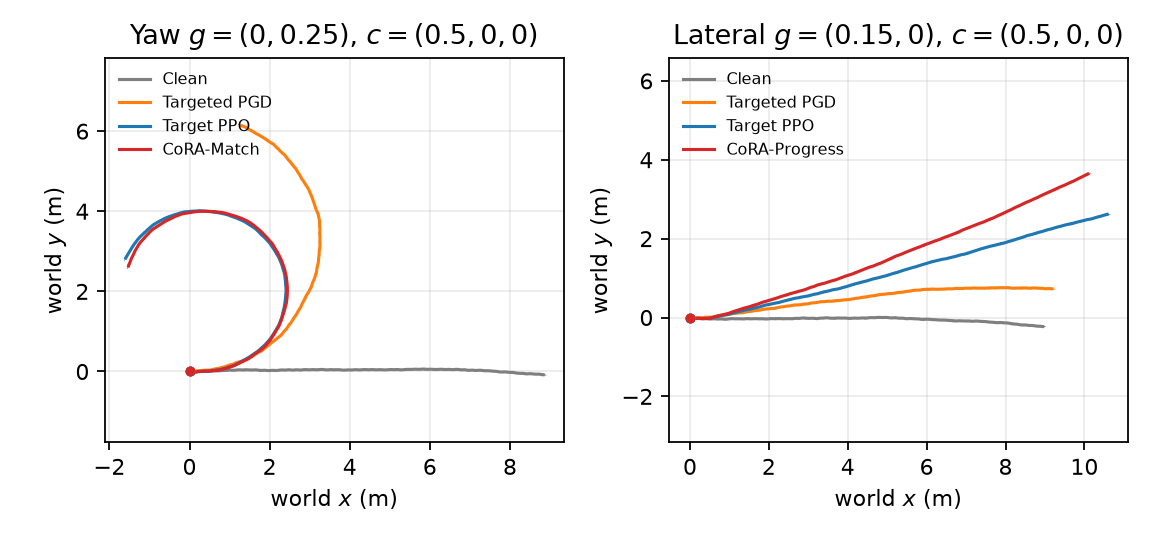
In these experiments, the original command requests forward motion. The attack induces turning, lateral movement, or both. The framework describes general original and target command pairs.
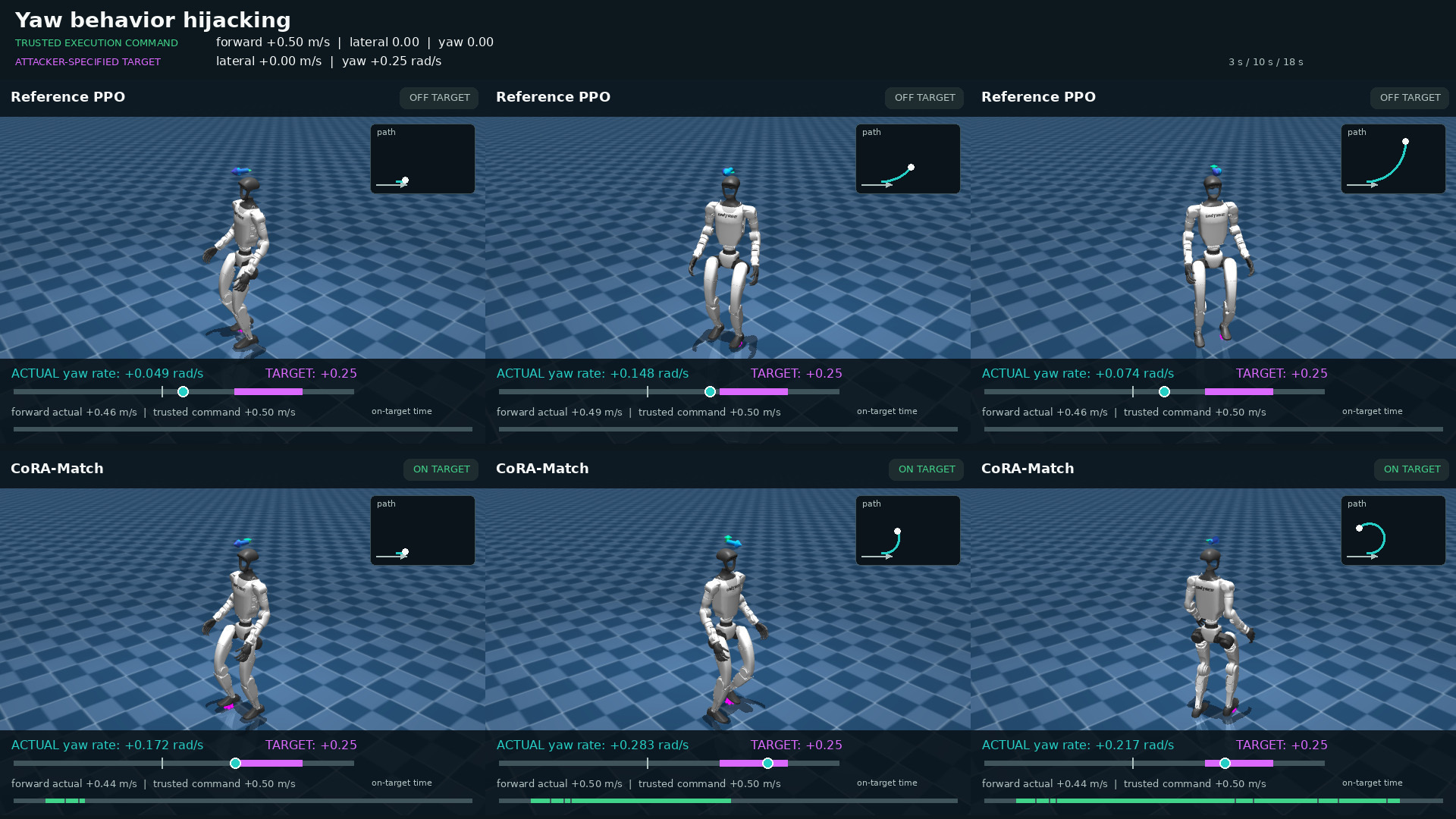
State & duration. ON/OFF TARGET labels show the current state. Green segments in the time bar mark on-target intervals.
Motion & path. Cyan readouts track actual behavior against the purple target band. The inset traces the bird’s-eye path.
Fall termination. Reward-min panels retain the FALL / TERMINATED label after the episode ends.
Individual 20-second simulation rollouts, synchronized across methods at original speed. The close-up view adds actual velocity–target curves. Aggregate occupancy and dwell across runs appear in the results below.
Matched frames at 3, 10, and 18 seconds connect the stepping posture to measured behavior and target status.
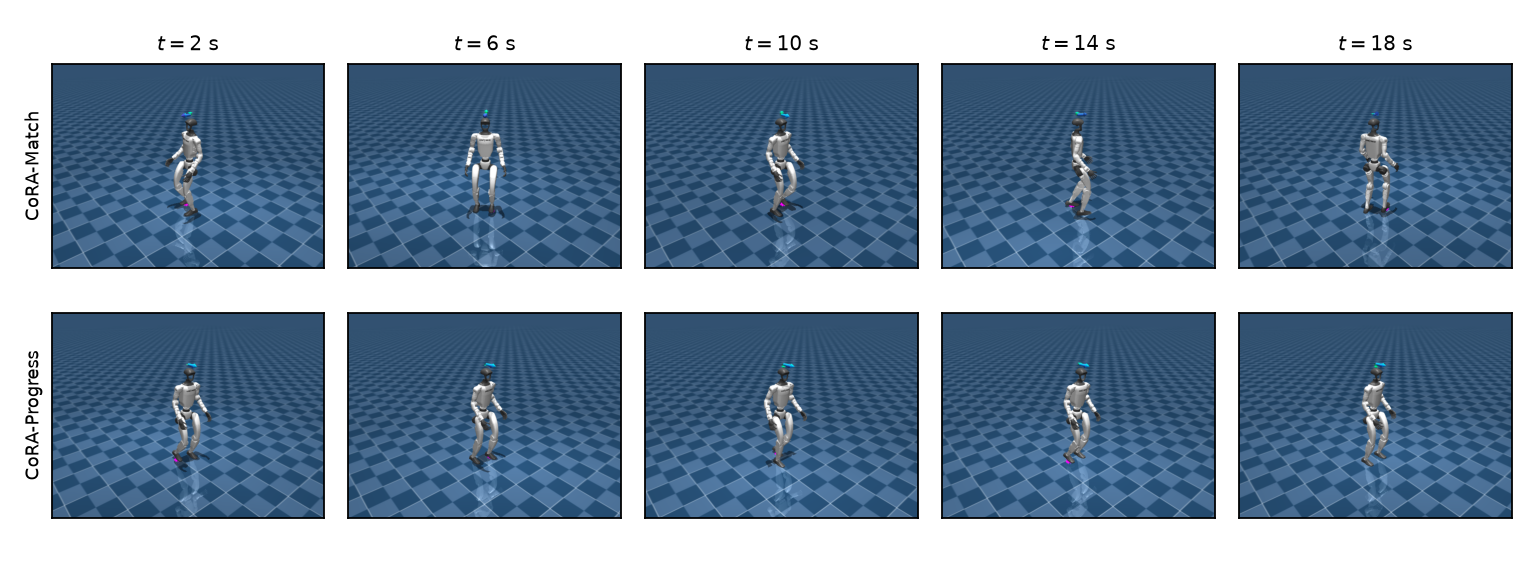
Swipe to explore frames · Tap to enlarge ↔
THE METHOD
Ask how the frozen controller would respond to the target command. Use that response to guide an observation attacker.
01 / REFERENCE
The controller provides a target-command action at the current state. CoRA-Match scores absolute agreement. CoRA-Progress scores how much of the nominal-to-reference gap is closed.
02 / LEARN
A learned attacker proposes observation residuals under magnitude and rate limits. Closed-loop feedback measures target motion, while regularization penalizes unstable or excessive perturbations.
03 / ANNEAL
The reference weight decreases to zero. The final training phase optimizes the behavioral reward and regularization. Deployment uses the trained attacker without reference queries.
THE EVIDENCE
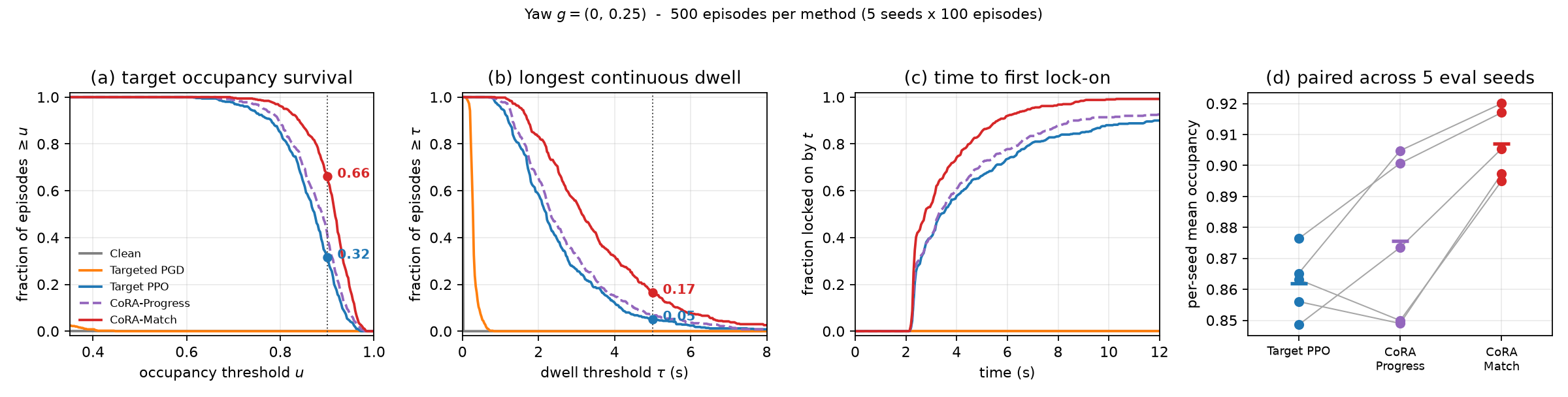
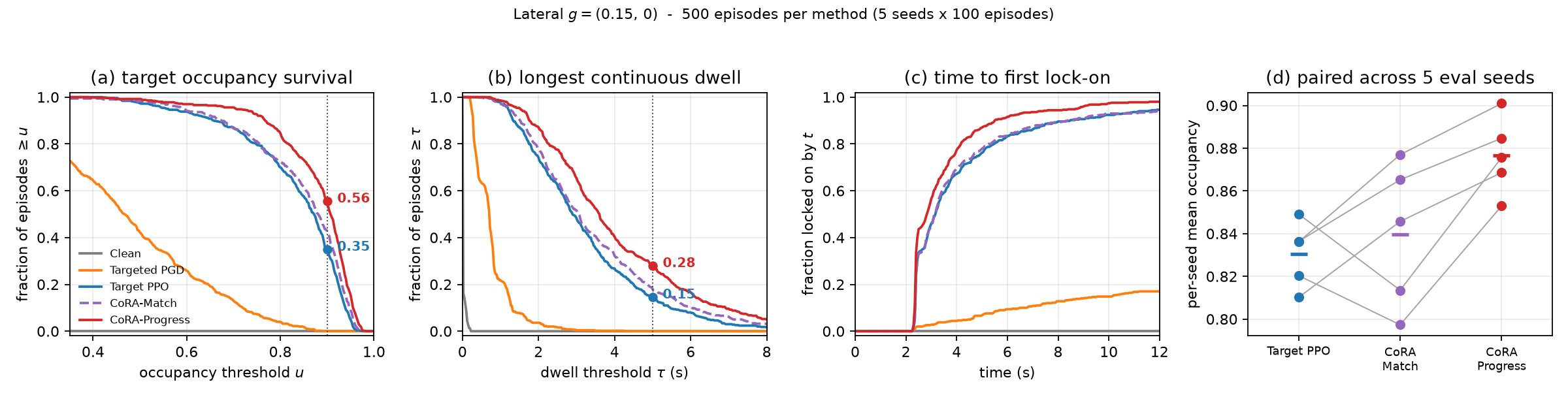
Compare sustained motion across three target settings.
Share of evaluation steps satisfying motion and stability conditions.
mean target occupancy
s
mean longest uninterrupted target motion
Swipe left to see all columns ↔
| Method | Occupancy (%) ↑ | Dwell (s) ↑ | Falls (%) ↓ |
|---|
Mean ± standard deviation over five runs. Each learned method uses five independently trained attackers and 100 evaluation episodes per run. Episodes last 20 s, with a 1 s warm-up. See Table 3 and the evaluation protocol for additional metrics.
WHAT THE ABLATIONS SHOW
The reference supplies an action-level learning signal. Motion feedback determines whether the intended behavior is realized.
Removing motion feedback sharply reduces occupancy. Keeping the reference weight constant also reduces occupancy on both tested targets.
| Training objective | Yaw | Lateral |
|---|---|---|
| Target only | 86.6 ± 1.8 | 85.5 ± 2.4 |
| Full CoRA | 89.3 ± 0.1 | 89.9 ± 1.1 |
| No annealing | 84.2 ± 2.5 | 83.1 ± 3.7 |
| Reference only | 2.3 ± 3.7 | 61.2 ± 5.5 |
Separate ablation runs from the main comparison. Source: Table 4.
THE TAKEAWAY
Continued locomotion can coexist with sustained behavioral deviation. Command adherence adds a complementary measure of reliability for learned robot controllers.
1 Wuhan University
2 Beijing Innovation Center of Humanoid Robotics
3 Wuhan University of Technology
4 Shenzhen Polytechnic University
* Equal contribution · † Corresponding author
CoRA learns bounded proprioceptive perturbations to induce specified humanoid motions while maintaining stable locomotion and leaving the execution command unchanged. A frozen controller supplies a target-command action reference during training. This guidance complements a reward based on measured motion and gradually decreases to zero. Comparative experiments on a simulated Unitree G1 controller show sustained behavioral deviation under bounded observation perturbations. CoRA-Match and CoRA-Progress achieve the highest mean target occupancy and longest uninterrupted target motion on the yaw and lateral tasks, respectively, among the evaluated methods.
@misc{wang2026cora,
  title = {Command-Referenced Observation Attacks for Behavior
           Hijacking in Humanoid Locomotion},
  author = {Wang, Zepeng and Ding, Ziluo and Zhang, Fengyi
            and Yuan, Kan and Shi, Xiaochuan},
  year = {2026},
  url = {https://xiaopeng-whu.github.io/CoRA/}
}